

Jochen Krisch und ich haben in den Exchanges über den heutigen Stand bei Amazon gesprochen: Exchanges #389: Amazon und Alexa 2026
Es wird wieder viel über KI und die Zukunft der Arbeit gesprochen. Ich habe ein paar Stimmen gesammelt und werfe im nächsten Briefing noch ein paar Papers zum Thema in die Waagschale. Im Grunde lässt sich das Thema eindampfen auf: lässt sich das Thema eindampfen auf:
KI transformiert die Arbeit. Transformation ist nicht Zerstörung. Zumindest nicht für alle, für manche Jobs schon.
Der Umgang damit wird eine der großen gesellschaftlichen Debatten der nächsten Zeit sein. Erst recht, wenn mehr Menschen dämmert, was die aktuellen Durchbrüche in der Robotik bedeuten werden.
Marcel
Im Fokus dieser Ausgabe:
- Zukunft der Arbeit und der Software: Das ist die große Debatte gerade. Paul Ford, Noah Smith, Annie Lowrey, Steven Sinofsky, Johannes Kleske, der Axios-CTO und Ben Thompson liefern sehr unterschiedliche Perspektiven. Meine Einordnung: Programmierung ist eine Ausreißertätigkeit, die von KI besonders betroffen ist. Was dort passiert, ist nicht automatisch die Blaupause für andere Wissensberufe.
- Embedded Engineers als neues KI-Beratungsmodell: Goldman Sachs baut mit eingebetteten Anthropic-Ingenieuren eigene Agenten. Das Palantir-Modell kommt in der KI-Wirtschaft an.
Für Mitglieder:
- Hyperscaler-Capex ist kein Bubble: Azeem Azhar mit der richtigen Einordnung.
- Europa fällt bei eigenen KI-Modellen weiter zurück.
- Autonome Trucks: Waabi sammelt bis zu 1 Mrd. Dollar und will exklusiv 25.000 Robotaxis auf Uber bringen. Gatik betreibt als erstes Unternehmen kommerzielle fahrerlose Trucks in größerem Maß.
- BYD überholt Ford bei weltweiten Fahrzeugverkäufen. Vor 5 Jahren verkaufte Ford noch fünfmal so viele Autos.
- und mehr
Zitat des Tages
5 million humanoid robots working 24/7 can build Manhattan in ~6 months. now just imagine what the world looks like when we have 10 billion of them by 2045. now imagine the year 2100.
David Holz auf X
Thema der Woche: Zukunft der Arbeit
Die Veränderung ist real, sie passiert jetzt, und sie betrifft Wissensarbeit im Kern. Aber trifft sie alle gleich?
„Ich hätte $25.000 für etwas bezahlt, das ich jetzt abends in der U-Bahn mache“
Der Tech-Autor und Unternehmer Paul Ford beschreibt in der New York Times, wie er abends auf dem Heimweg in der New Yorker U-Bahn KI-Coding-Agenten Projekte bauen lässt. Zwischen zwei Stationen gibt er Prompts ein; wenn er in Brooklyn ankommt, ist das Projekt oft fertig. Paul Ford, The New York Times:
When I rebooted my messy personal website a few weeks ago, I realized: I would have paid $25,000 for someone else to do this. When a friend asked me to convert a large, thorny data set, I downloaded it, cleaned it up and made it pretty and easy to explore. In the past I would have charged $350,000.
That last price is full 2021 retail — it implies a product manager, a designer, two engineers (one senior) and four to six months of design, coding and testing. Plus maintenance. Bespoke software is joltingly expensive. Today, though, when the stars align and my prompts work out, I can do hundreds of thousands of dollars worth of work for fun (fun for me) over weekends and evenings, for the price of the Claude $200-a-month plan.
Das sind Erfahrungen, die gerade viele machen und daraus ihre Schlussfolgerungen ziehen. Ausgelöst durch die Modelle, die Ende 2025 erschienen. (siehe Briefing 277)
Das kann nicht ohne Folgen bleiben:
That's not an altogether pleasant feeling. The faces of former employees keep flashing before me. All those designers and JavaScript coders. I could not hire the majority of them now, because I would have no idea how to bill for their time. Some companies, including IBM, think A.I. will create tons of new jobs. But no one thinks they'll be the same as the old jobs.
People trumpet the Jevons paradox, which points out that greater efficiency often leads to more consumption — but at the same time, would it surprise you to find out tomorrow that large technology consulting firms had just laid off 10,000 people? A hundred thousand? A million?
Nicht jede:r wird Programmierer:in, aber das Wesen von Software wird sich in den nächsten Monaten radikal wandeln.
I think if vibe coding gets a little bit better, a little more accessible and a little more reliable, people won't have to wait on us. They can just watch some how-to videos and learn, and then they can have the power of these tools for themselves. I could teach you now to make a complex web app in a few weeks. In about six months you could do a lot of things that took me 20 years to learn. I'm writing all kinds of code I never could before — but you can too.
Dazu passend auch die Aussagen des Axios-CTO Dan Cox.
Axios CTO: Ein Entwickler, 37 Minuten statt 3 Wochen
One of our best engineers recently completed a project similar to one he delivered a year ago.
Last year, it took three weeks. This past week, he used AI-based "agent teams" and completed the same amount of work in 37 minutes.
The team doubled its output in January and will double that again this month. We're doing exponentially more ... with dramatically fewer people.
Anticipating this AI shift six months ago, we refocused our product and tech organization, shrinking from 63 to 43 people to operate more nimbly in this new environment.
Tech debt is gone. Not because we solved it, but because AI just made it irrelevant.
The Axios backlog, which was 12 months long, will be gone in months. Then the work really starts, as engineers become builders and begin to think beyond the limits of a request list.
(Hervorhebungen von mir)
Das sind enorme Sprünge, so groß, dass kein Unternehmen sich dem verschließen kann.
Cox nennt interessante Folgen daraus:
The bottleneck is no longer writing code. It's how fast humans can absorb change. We might end up creating things faster than humans can keep up. That could create feature fatigue ("Another update? We just had one")... trust erosion ("Do they have a vision for all this STUFF?") ... and cognitive overload ("I just learned the old way!").
Axios hat angeblich bereits vor zwei Jahren begonnen, sich darauf vorzubereiten:
That's why we shared the figures above from Dan — a 30% reduction in our product and tech team last year, given AI's coming capabilities. We started preparing for this almost two years ago, when that team was 90 people.
Der Niedergang der Nerds?
Noah Smith argumentiert in einem langen Essay: Was gerade passiert, ist das Ende einer ökonomischen Ära. Sein ganzes Leben lang hat er den Aufstieg einer breiten sozialen Klasse technischer Fachkräfte erlebt. Das könnte jetzt vorbei sein.
Just as a power loom allowed an unskilled peasant to make cloth almost as good as what a master weaver would make — and at a fraction of the price — new AI coding tools are making it possible for relatively unskilled workers to turn out vast reams of software that's almost as good, and far cheaper, than what a master software engineer would make.
Software-Engineering war möglicherweise weniger ein „Creative Class"-Job als gedacht und mehr eine „Routine Cognitive"-Aufgabe, also genau die Art, die besonders anfällig für Automatisierung ist.
Die Folgen: Lohnkompression (KI stärkt Schwächere relativ stärker), Machtverschiebung zu Kapital (GPUs, Rechenzentren), und Tech-Hubs wie San Francisco verlieren an Relevanz. Softwareingenieure tauschen sich nicht mehr untereinander aus; sie bekommen ihre Ideen von der KI.
Der iShares-Software-ETF verlor in sieben Tagen über eine Billion Dollar.
Private Equity und die Software-Wette, die kippt
Passend dazu: Die Financial Times berichtet, wie KI die große Wette der Private-Equity-Branche auf Software zerstört. Software machte rund 40% der PE-Deals des letzten Jahrzehnts aus. Das SaaS-Playbook war bekannt und berechenbar (und attraktiv).
This month the value of the world's largest software companies like Salesforce and ServiceNow plunged by a fifth. The investor angst quickly spread to finance as the shares of large private capital groups such as Blackstone, Ares, KKR and Blue Owl dropped sharply, signalling growing fears about their exposure to software investments.
Takeovers of software companies by private equity funds accounted for about 40 per cent of trillions of dollars in deal activity over the past decade by some estimates. Such deals also represent nearly a third of lending in the fast-growing private credit industry.
Programmieren als die Ausreißertätigkeit, die besonders von KI betroffen ist
Das alles bringt mich zu zwei Beobachtungen, die Ben Thompson jüngst in seinen Podcasts machte.
Im Sharptech-Podcast machte er die Beobachtung, dass SWE eine besondere Tätigkeit ist, die sich von fast allen anderen menschlichen Tätigkeiten unterscheidet. Menschen programmieren Computer, sie müssen dafür denken wie Computer; wieso sollten Computer nicht besser darin sein, Computer zu programmieren?
Wenn man einmal darüber nachdenkt, wird es immer offensichtlicher:
Softwareentwicklung, zumindest der Code-Teil, hat viele, enorme Vorteile für LLMs: für LLMs: Sie können das Ergebnis selbst testen. Und Code-Text ist perfektes Trainungsfutter (und Reinforcement-Learning-Futter). Programmiersprachen folgen einer viel strikteren Logik als ungenaue menschliche Sprachen. Viele Aufgaben in der Softwareentwicklung sind repetitiv und folgen festen Mustern. Viel Code ist sogenannter Boilerplate Code, der nur als notwendiges Gerüst dient. Das Erstellen von Testfällen lässt sich oft logisch direkt aus dem Funktionscode ableiten. usw. usf.
Hier ist aber der wichtige Punkt: Aus alldem können wir nicht, wie es etwa Altman oder Amodei machen, automatisch ableiten, dass in naher Zukunft alle Jobs von KI übernommen werden. Softwareentwicklung ist extrem computerzentrisch und das macht es angreifbar für diese neue Art von Computern.
Was aktuell Programmierer:innen passiert, ist nicht zwingend die Vorschau für den Rest der Büroangestellten. Vielleicht sind sie einfach nur dieses Mal als erste und vielleicht auf absehbare Zeit als einzige dran und nicht die Musiker:innen und Journalist:innen wie beim letzten Mal.
In ihrem Dithering-Podcast haben Thompson und John Gruber noch eine gute Beobachtung gemacht: Bis in die 1980er war es so, dass die Tech-Branche regelmäßig von Disruptionen erschüttert wurde. Unternehmen hielten sich in der Regel nicht lang, ein Paradigma löste das nächste ab. Das änderte sich in den 1990ern mit der anhaltenden Dominanz von Microsoft und verfestigte sich weiter ab den 2000ern mit dem Aufstieg der Internetriesen. Selbst Microsoft hat den Wandel vom abgeschiedenen Desktop zur Internetära gut überlebt.
Jetzt kehren wir wieder in eine Tumult-Ära im Tech-Sektor zurück.
Das wäre eigentlich auch eine große Chance für Europa, but alas.
(Die großen Konzerne sind als Infrastrukturdienstleister zwar relativ sicher. Aber darunter? All bets are off.)
Steven Sinofsky: Mehr Software, nicht weniger
Steven Sinofsky, Ex-Microsoft heute a16z, hält gegen die Annahme von Smith et al, dass die Zeit der Software-Nerds abgelaufen sei. Seine zentrale These: Es wird mehr Software geben als je zuvor. Nicht weniger.
Here's what will happen:There will be more software than ever before.AI-enabled or AI-centric software is simply moving up the stack of what a product is.New tools will be created with AI that do new things.
Das ist alles schön und gut. Ein interessanter Gedanke ist, dass KI dafür sorgt, dass die mögliche Expertise noch tiefer gehen wird:
Domain experience will be wildly more important than it is today because every domain will become vastly more sophisticated than it is now. This is not just because of service providers and builders have better tools, but because customers do as well. I will never forget how bankers said they were going to be so much more efficient by having a few college kids use spreadsheets while they did all the hard work of deal-making. Little did they know that to even be a banker by 1995 you were going to be the person using the sheet to build a model. Repeat for consultants. Graphic artists. Writers. Lawyers. Doctors. And every single domain. This is going to happen all over again. Yes, some supporting jobs in domains went away, but they were not just replaced with even more skills, they were replaced with many more people. More people work in more banking locations today, per capita, than ever before. There's more expertise required in every domain, even with three decades of automation. [...]
Das ist sehr wahrscheinlich. Das Internet hat hochspezialisierte Nischen ermöglicht. KI wird ähnliches tun. (Bei KI kommt es von der Input-Seite, beim Internet von der Distributionsseite.)
Tiefe Expertise wird stärker als heute verbunden sein mit menschlicher Authorität (personal branding etc.). Völlig offen natürlich, wie sich das im Spiel mit den wachsenden Fähigkeiten der KI austarieren wird.
And finally:
Finally, it is absolutely true that some companies will not make it. It is even true that in some very long time, longer than a career or generation, every company will be completely different or their product line and organization will have dramatically changed.
Daran lässt sich nichts ändern, alles andere wäre eine sehr merkwürdige strukturelle Veränderung.
Oder wie es Derek Thompson auf X sagt:
There's no excuse for AI apathy among policymakers. No off-ramp where AI doesn't matter. Either
a) the largest private-sector spending project in history fails to pull along revenue, in which case the odds of an industrial/financial bubble are too high too ignore; or
b) the revenue comes along, which implies AI deployment in the economy will be absolutely furious. And it's hard to imagine that companies shift hundreds of billions of dollars of annual spending toward tokens and agents without reducing spending, at the least in the short run, on labor, implying meaningful labor market displacement
The Goldilocks scenario—no bubble, no job loss, the entire economy just seamlessly coordinates the addition of 100s of billions of dollars of additional annual spend without any dislocation for workers—is possible, I guess, but it's really really hard to imagine.
KI-Trend: Embedded Engineers für Implementierung
Dazu passend, Goldman Sachs baut mit Anthropic eigene Agenten. CNBC:
Goldman Sachs has been working with the artificial intelligence startup Anthropic to create AI agents to automate a growing number of roles within the bank, the firm's tech chief told CNBC exclusively. The bank has for the past six months been working with embedded Anthropic engineers to co-develop autonomous agents in at least two specific areas: accounting for trades and transactions, and client vetting and onboarding, according to Marco Argenti, Goldman's chief information officer.
(Hervorhebung von mir)
„Embedded engineers“ ist das Modell von Palantir für aufwendige Technikimplementierungen, das jetzt von den KI-Unternehmen übernommen wird. OpenAI hat auch bereits „Solutions Architects“: Expert:innen, die Unternehmen bei der KI-Einführung und Best Practices begleiten.
Diese „Embedded engineers“ könnten in den nächsten Jahren noch verhasster werden als Unternehmensberater, siehe das nächste Segment.
Worst-Case-Szenario für White-Collar-Arbeiter oder eher bei 1999
Der Arbeitsmarkt für Büroangestellte beginnt sich zumindest in den USA zu verschieben, schreibt der Atlantic:
But the labor market for office workers is beginning to shift. Americans with a bachelor's degree account for a quarter of the unemployed, a record. High-school graduates are finding jobs quicker than college graduates, an unprecedented trend. Occupations susceptible to AI automation have seen sharp spikes in joblessness. Businesses really are shrinking payroll and cutting costs as they deploy AI. In recent weeks, Baker McKenzie, a white-shoe law firm, axed 700 employees, Salesforce sacked hundreds of workers, and the auditing firm KPMG negotiated lower fees with its own auditor. Two CNBC reporters with no engineering experience "vibe-coded" a clone of Monday.com's workflow-management platform in less than an hour. When they released their story, Monday.com's stock tanked.
Die Folgen würden die gesamte Wirtschaft treffen:
If rich households cut back on spending, many businesses that have nothing to do with AI—grocery stores, gas stations, retail shops, hairdressers, restaurants—would suffer and the labor market would keep deteriorating. The housing market would begin to falter; home prices in many regions would fall and fewer properties would go to market. Tax revenue might fall.
Bevor das passiert, wird es allerdings zu massivem politischen Widerstand kommen. White Collar ist besser vernetzt und dadurch politisch involvierter als Blue Collar. Wenn die Gesamtheit der Arbeitsplätze für Anwälte spürbar rückläufig werden sollte, werden Politiker:innen mit Jura-Examen entsprechend handeln. 14,8 Prozent der Abgeordneten im Bundestag sind Rechtsanwältinnen und Rechtsanwälte.
Der Berliner Zukunftsforscher Johannes Kleske setzt die Job-KI-Hysterie in den Kontext der deutschen Arbeitsmarktrealität.
The great fallacy with AI and work is that we only ever look at the existing system and speculate how AI might accelerate and automate it in the short term. We only imagine existing jobs disappearing. We have a hard time imagining new jobs emerging that wouldn't make any sense in the current system but would become rather obvious once the system adapts.
If we're truly at a 1999-equivalent moment with AI, then the things that will actually matter haven't been built yet. Feeling like you've already missed it is the FOMO talking. And FOMO is a product of the hype, not a reflection of reality.
In Germany right now, we desperately need more workers. The government is trying to convince us all that we need to work more. Many people have already experienced burnout due to excessive workload. But at the same time, a growing number of employees are afraid that they're soon going to be replaced by AI.
How does that work? How are we supposed to go from "we should all work more" to "AI has replaced us all" in an instant?
Es ist offensichtlich, dass wir auf eine turbulente Umbruchszeit zusteuern.
Meine These ist seit einigen Jahren, dass KI (und mehr noch Robotik, die im Verbund mit KI mehr Automatisierung übernehmen kann) ein Geschenk für den deutschen Arbeitsmarkt ist, der auf eine Boomer-Katastrophe zusteuert.
Historisch: Ganze Berufskategorien verschwunden
Last not least ein historischer Thread auf X, der zeigt, welche White-Collar-Jobs in der Vergangenheit komplett verschwanden. It ain’t new. Judge Glock auf X:
Mail Room. This was the proverbial "from the bottom" job in 20th century movies about office life. Look at the movies and these things were packed with people, they pushed memos up and down the office food chain. Largely gone.
Have you ever heard of a typing pool? A variation on copyists, but people who just took everything handwritten and typed it on a typewriter and typed new versions out for other people. Every big company had one.
Computer, yes, the human kind. All of those "hidden figures" in movies and books came from a massive number of people just typing and retyping numbers into adding machines. This actually includes most of what old fashioned "accountants" did too.
Data Entry. Later, but many people including me, spent months taking numbers people wrote on pieces of paper and typing them into a physical computer. Now much rarer.
There were weird jobs too like newspaper clipper. Whole firms just looked through newspapers and clipped relevant stories for people who paid them to do so.
- Briefing 260: KI & Jobs: Eine Verschiebung der Wertschöpfungsnetzwerke
- Briefing 253: KI und Arbeit: Jobs als Taskbündel; Freelancer trifft es zuerst
- Nexus 236: KI-gestützte Beschleunigung der Arbeit
🤖 Mehr KI
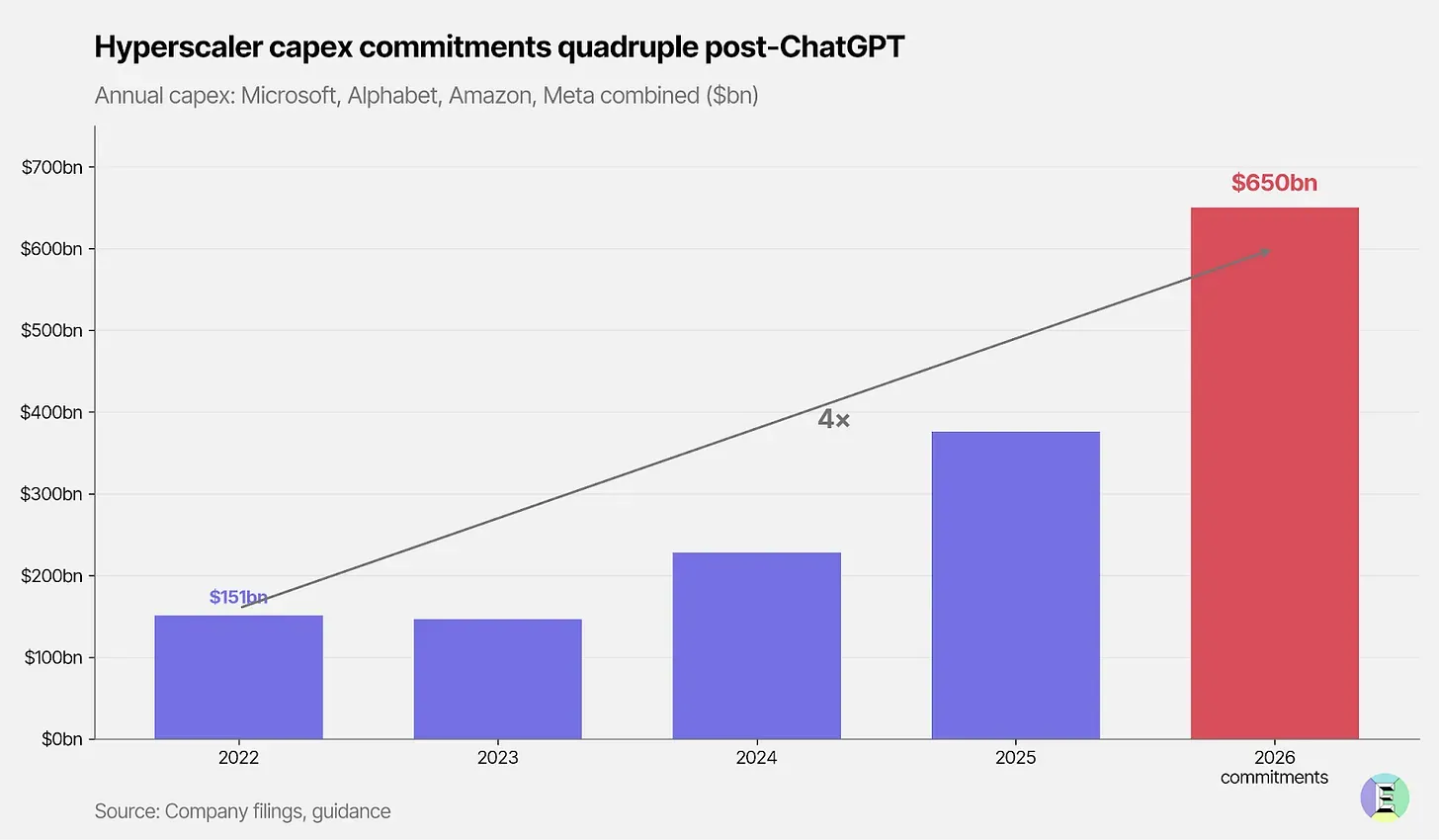
Big-Tech-Capex war schon immer big
Ein Nachtrag zu den Investitionsausgaben der großen Tech-Konzerne.
Exponential View hat die Zahlen von 2022 mit aufgenommen:
Lesen Sie die ganze Geschichte
Melden Sie sich jetzt an, um die vollständige Geschichte zu lesen und Zugriff auf alle bezahlten Beiträge zu erhalten.
Abonnieren